
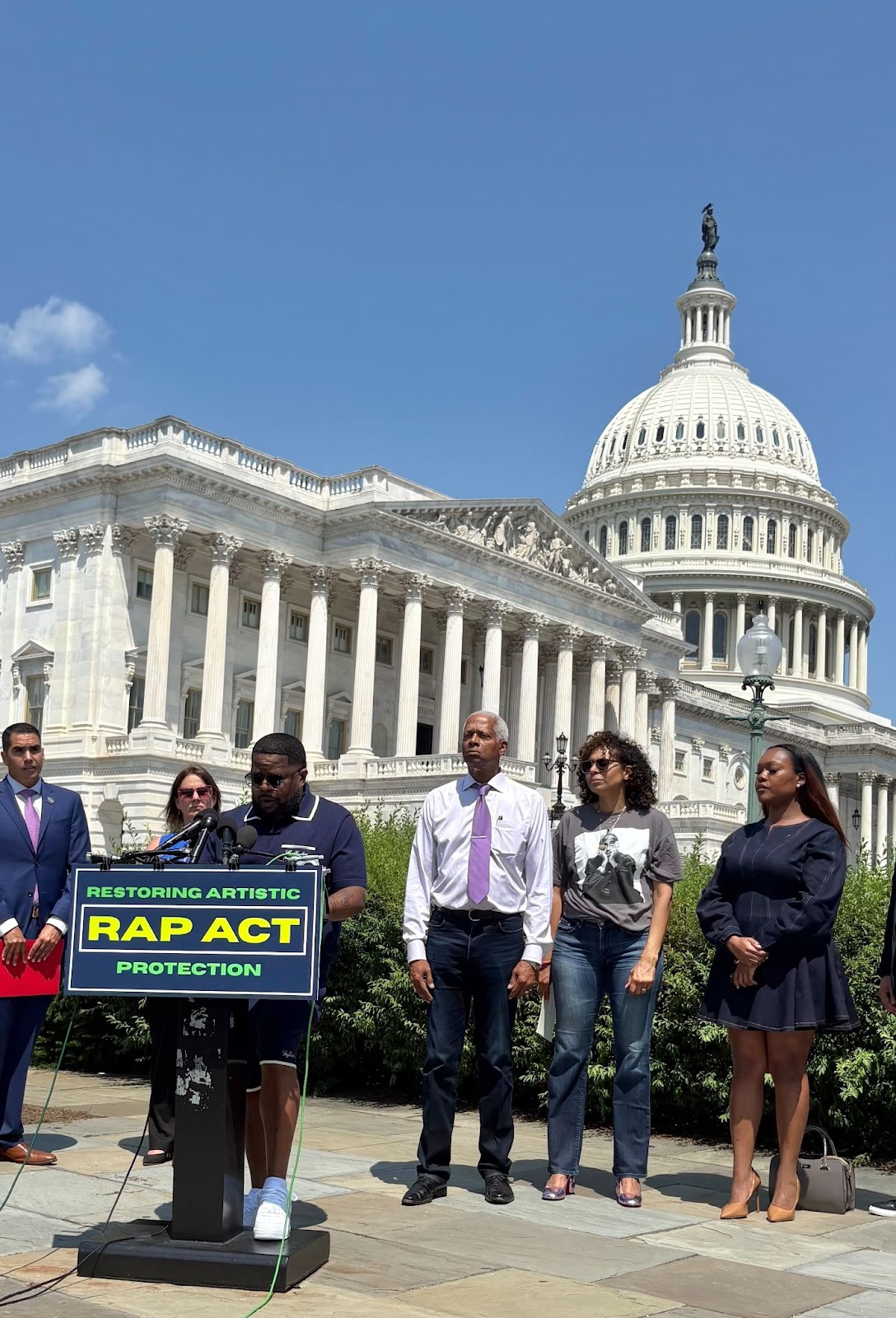
— The Black Music Action Coalition (BMAC) announces its support for the “Restoring Artistic Protection Act” (“RAP Act”).
The legislation, re-introduced by Congressman Hank Johnson (GA-04) and Congresswoman Sydney Kamlager-Dove (CA-37), seeks to protect artists from the wrongful use of their lyrics against them in criminal and civil proceedings. The legislation, originally introduced in the 117th Congress, is the first bill of its kind at the federal level. The RAP Act adds a presumption to the Federal Rules of Evidence that would limit the admissibility of evidence of an artist’s creative or artistic expression against that artist in court.
As of June 2025, researchers have identified more than 820 instances of creative works being used in criminal trials from media reports and the appellate record alone. These cases most often revolve around the presentation of a defendant’s rap lyrics as literal confession, despite the genre’s well-known motifs of exaggeration, braggadocio, and playfulness. In practice, it is a loophole to admit character and propensity evidence, which are explicitly prohibited under Federal Rules of Evidence.
“The Black Music Action Coalition supports and applauds Representatives Hank Johnson and Sydney Kamlager-Dove for their leadership and commitment to justice through the proposed RAP Act, which challenges the systemic injustice of using lyrics as evidence in criminal trials. Hip-hop was born from resistance. It is raw, real, and often uncomfortable — but discomfort is not evidence. Metaphor is not motive. And art is not a crime. Rap music is a powerful form of expression, rooted in truth and cultural identity. It deserves the same First Amendment protection and freedom of speech guaranteed to all forms of art. Hip-hop is not just the heartbeat of popular music — it is a cornerstone of American culture. We must protect it, not prosecute it.” — Willie “Prophet” Stiggers, President & CEO of the Black Music Action Coalition (BMAC)
Read more from Prophet in a speech entitled “From the Studio to the Stand: Ending the Criminalization of Black Art.”
“This legislation is long overdue. For too long, artists – particularly young Black artists – have been unfairly targeted by prosecutors who use their lyrics as evidence of guilt, even though there is no evidence that the lyrics are anything more than creative expression. When you allow music and creativity to be silenced, you’re opening the door for other realms of free speech to be curtailed as well. The government should not be able to silence artists simply because they write, draw, sing, or rap about controversial or taboo subjects. The Restoring Artistic Protection Act (RAP Act) would protect artists’ First Amendment rights by limiting the admissibility of their lyrics as evidence in criminal and civil proceedings. I thank my colleague Congresswoman Kamlager-Dove for joining me in co-leading this legislation.” — Congressman Hank Johnson
“Weaponizing lyrics or other creative works in court is a harmful tactic that stifles artistic expression and undermines the voices of not just musicians, but all who create and shape culture. With the reintroduction of the RAP Act, we continue to build momentum for ending this unjust practice. The Recording Academy is grateful to our Congressional partners, Representatives Johnson and Kamlager-Dove, for their leadership on an issue that poses real harm to creators in music and beyond.” — Harvey Mason jr., CEO, Recording Academy
“History has taught us that taking an artist’s creative expression out of context is dangerous. The RAP Act prevents this and prohibits lyrics from being used against all artists in a court of law. The consistent practice by prosecutors of only introducing rap lyrics when artists of color are on trial is discriminatory and must be stopped. MAC applauds Rep. Johnson for his efforts.” — Susan Genco, Board Member, Music Artist Coalition (MAC)
“Musical lyrics of all genres can be alliterative, fantastical, boastful and at times, even hyperbolic. But what they are not intended to be — or marketed as — is ‘truth’. Prosecutorial tactics that use lyrics as ‘evidence’ of guilt without regard to due process and the freedom of expression are deeply disturbing and we commend Ranking Member Johnson for introducing the RAP Act, a commonsense protection against this troubling practice.” — Jeffrey Harleston, General Counsel and Executive Vice President, Business & Legal Affairs, Universal Music Group
“The Songwriters of North America (SONA) fully supports and endorses the RAP Act, which addresses the troubling and discriminatory practice of using lyrics and other forms of creative expression as evidence in criminal proceedings. This tactic, deeply rooted in systemic racism, has been used primarily to target rap artists — most often young Black men — for simply exercising their right to free speech. The RAP Act represents a critical opportunity to protect artistic freedom, correct injustice, and uphold the constitutional rights of all Americans.” — Dina LaPolt, Co-founder and Board Member, Songwriters of North America (SONA)
“Artists of all mediums, whether that be music, film, or literature, should be free to create without fear that their works will unjustly be used against them. We thank Congressman Johnson and Congresswoman Kamlager-Dove for standing up for Americans’ free speech rights and championing this important piece of legislation.” — Greg Gonzalez, Legislative Counsel, Foundation for Individual Rights and Expression (FIRE)
“The Artist Rights Alliance strongly supports the RAP Act and applauds Congressman Hank Johnson for his continued leadership in fighting to protect artistic freedom. The targeted use of rap lyrics in prosecutions undermines our country’s foundational principles of free speech and equal protection under the law. The RAP Act is a vital step toward ending this discriminatory practice and ensuring that rap artists can safely enjoy their First Amendment rights without fear that their own work might be weaponized against them in a courtroom.” — Jen Jacobsen, Executive Director, Artist Rights Alliance (ARA)
“We applaud the reintroduction of this important legislation that will allow all creators to follow their artistic vision without barriers of prejudice. All too often Rap and Hip-Hop artists have been punished for the same kind of hyperbole and imagery other genres routinely use without consequence. Courts should consider relevance, not assumptions.” — Michele Ballantyne, President & COO, RIAA
The First Amendment guarantees the right to freedom of expression, but freedom of expression is stifled when safeguards are not in place to ensure that an artist’s art is not wrongfully used as evidence against that artist. The RAP Act puts those safeguards in place to ensure that First Amendment protection is a reality for all artists in America. For more information, be sure to read the entire bill.